


The Best of Flow Reps. Straight to your inbox.
A Monthly Email Packed With SOLUTIONS! Not decision.
Thank you! Your submission has been received!
Oops! Something went wrong while submitting the form.

Materials & Compatibility
What is Normalizing? The Definition, Process, Advantages, and Applications for Normalizing

KEY TAKEAWAYS
Normalizing is a widely popular heat treatment process for metals to increase ductility and toughness. This heat treatment is also known as normalizing annealing as the normalizing heat treatment process is very similar to annealing treatment. In this article we will learn more about normalizing; its definition, purposes, process steps, applicability, normalizing vs annealing, etc.
Normalizing is defined as a heat treatment process where a material is heated to a predecided elevated temperature, hold at that temperature for a certain period of time (usually 10-20 minutes), and then allowed to cool freely in the air to reach room temperature. The normalizing process is usually applied to metals that have been subjected to thermal or mechanical hardening processes and require their microstructure to be normalized. After normalizing, the metal gets back its ductility and the hardness is reduced.
For the normalizing treatment of a metal, it must be receptive to normalizing. Various metals and alloys are suitable to be normalized like
The main purposes of the normalizing heat treatment on metals are:
Similar to annealing the normalizing process also follows three main stages; the Recovery stage, the Recrystallization stage, and the grain-growth stage. In the recovery stages of normalizing, the internal stresses are relieved by heating the material. Then the metal is heated to elevated temperatures above the recrystallization temperature of the metal where new grains are formed. Finally, in the grain growth stage of normalization, the grains develop fully when the material is cooled by air.
Normalizing treatment finds broad practical applications across several industries like Aerospace, Automotive, Heavy Equipment, Energy, Agriculture, Oil & Gas, etc. Usually, whenever metal is expected to get high residual stresses due to some kind of manufacturing steps, it is always suggested to normalize the metal using the normalizing heat-treatment process. A few examples include:
Steel normalizing is a heat treatment process performed after rolling, welding, or forging processes to refine the distorted grains in the microstructure. The normalizing process of steel involves the following steps:
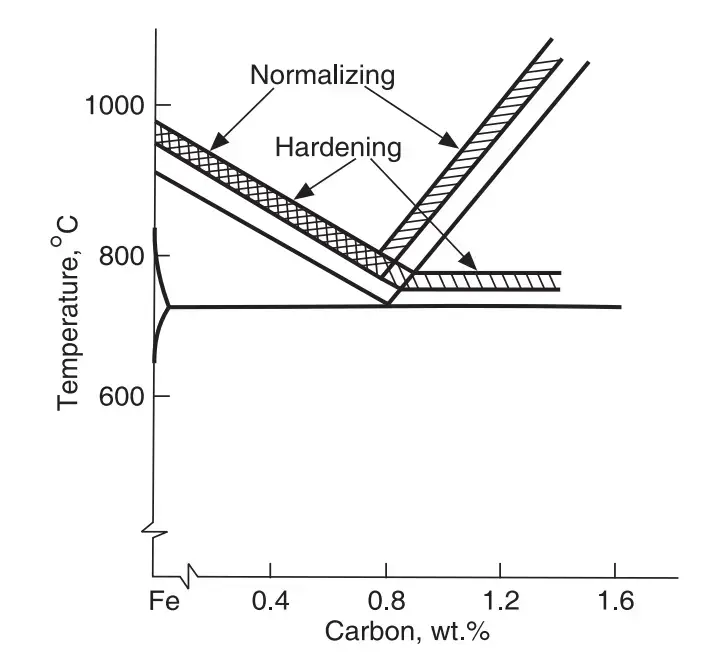
After normalizing, the resultant microstructure is usually perlite. The grain size in normalizing steel is governed by the section thickness. A variation in grain size is observed as the cooling rate varies from the case to the core. The normalizing temperature of steel varies with the carbon content as is clear from Fig. 1. The following table (Table 1) provides recommended normalizing temperatures for steel.
Even though the process steps for normalizing and annealing are almost similar there are specific differences between normalizing and annealing. The differences between annealing and normalizing are provided below in a tabular (Table 2) format.
NormalizingAnnealingThe cooling rate in normalizing is faster than annealing.Slower cooling rate as compared to normalizing.Slow cooling in room temperature.Controlled slow cooling in a furnace.Mechanical Strength and hardness of normalized components are more.Strength and hardness are lower as compared to the normalized parts.Machinability is more improved in normalizing.Annealed product is soft and thus can stick to the machine during machining.Slightly less ductility.More ductility.Less expensiveComparatively costlyTable 2: Normalizing vs Annealing
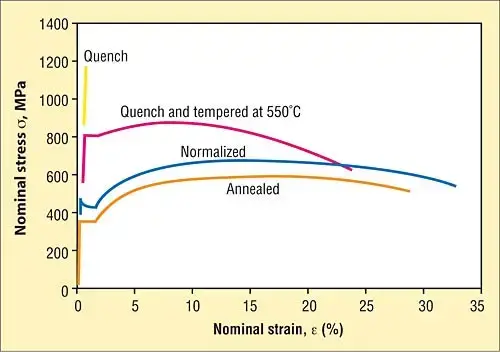
The image in Fig. 2 shows the typical differences in nominal strength between Normalized and Annealed steel.

Heading for Linked Resource


